Long Beach municipal water meets all federal and state safe drinking water standards, but meeting regulatory minimums and delivering water that performs optimally in your home are two different measures. The Long Beach Water Department sources water from a combination of local groundwater, Metropolitan Water District surface water treated at regional treatment plants, and water recycling programs. The treatment processes use chloramines rather than free chlorine as the primary disinfectant residual, which affects both the taste of the water and the performance of certain filtration media. Long Beach Pro Plumbing Inc installs water filtration systems calibrated to what is actually in Long Beach water.
Chloramine removal requires a different filtration approach than free chlorine removal. Granular activated carbon, which is effective at removing free chlorine very rapidly, works much more slowly on chloramines. Catalytic activated carbon, produced through a high-temperature treatment process that modifies the surface chemistry of the carbon, adsorbs chloramines significantly more effectively than standard GAC. Any carbon-based filter installed in a Long Beach home should use catalytic carbon media to actually address the chloramine residual in the supply.
Reverse osmosis systems produce the most thoroughly filtered drinking water available in a residential setting. A standard RO system uses a sediment prefilter to remove particulate matter, a carbon block prefilter to remove chloramines and organics that would damage the membrane, the semi-permeable RO membrane itself, and a post-filter polishing stage before the water reaches the dedicated drinking water faucet. The membrane rejects a high percentage of dissolved solids including nitrates, arsenic, lead, chromium-6, fluoride, and most pharmaceutical compounds.
RO systems produce water at a relatively slow rate and store the filtered water in a pressure tank under the sink. A standard residential RO tank holds two to four gallons of filtered water. The ratio of filtered water produced to drain water discharged varies by membrane efficiency, with older membranes producing as much as four gallons of drain water for every gallon of filtered water, while high-efficiency membranes achieve ratios close to 1 to 1.
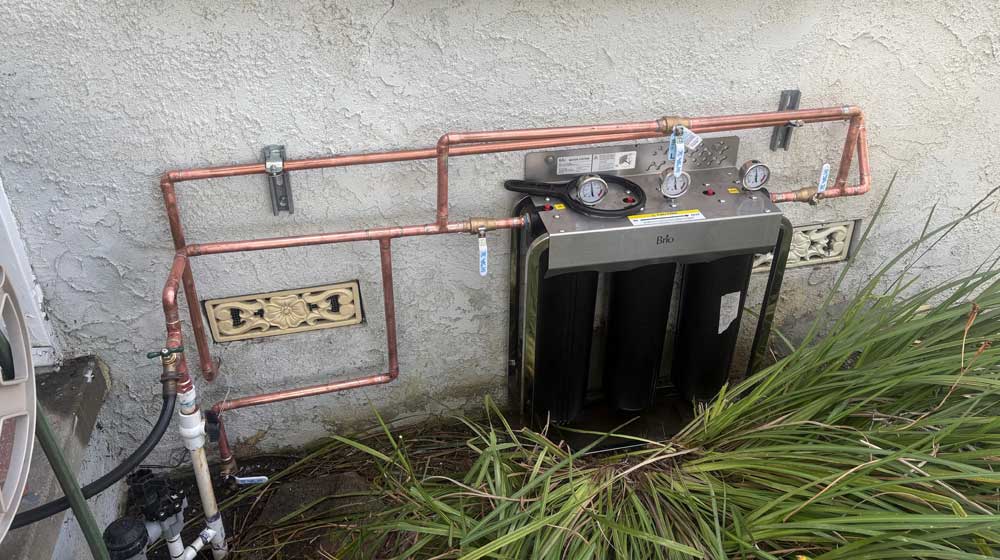
Whole-home filtration systems treat all water entering the house before it reaches any fixture. A whole-home system typically combines a sediment filter to protect downstream components, a primary treatment stage appropriate to the water chemistry, and sometimes a UV disinfection stage. For Long Beach homes concerned about chloramine exposure through showering and bathing as well as drinking, a whole-home catalytic carbon filter addresses the full usage picture rather than only the drinking water at one faucet.
Water softeners address hardness minerals separately from filtration. Long Beach water hardness varies by source blend but typically runs in the moderately hard range that promotes scale formation in water heaters, fixtures, and appliances. Ion exchange softeners replace calcium and magnesium ions with sodium through a resin bed that regenerates on a timed cycle using salt. We size softener systems to the household water volume and hardness level.